
As Super Typhoon Ragasa struck southern China in late September 2025, unusual images began circulating online: cars strapped tightly to trees with ropes. At first glance, the sight looked bizarre, but for local residents it was a desperate attempt at storm protection.

With wind speeds reaching more than 200 km/h, even heavy vehicles risk being shifted, overturned, or swept away. To reduce damage, residents in Guangdong and surrounding provinces used thick ropes to anchor their cars to sturdy trees, poles, or other fixed structures. This improvised method, while not foolproof, helps prevent cars from rolling into buildings, blocking roads, or being carried by floodwaters.
Typhoon Ragasa forced the evacuation of nearly 1.9 million people in Guangdong. Rail services, schools, and businesses were suspended. Along the coast, hurricane-force winds, torrential rains, and severe flooding were reported, with major disruptions in Shenzhen, Zhuhai, and Yangjiang.
Although tying cars to trees may appear unusual, it illustrates how people adapt quickly in the face of increasingly powerful tropical cyclones. For many families without access to garages or secure shelters, ropes and strong trees became their last line of defense against the world’s strongest storm of the year.
Photo: Viral image shared on social media during Typhoon Ragasa.
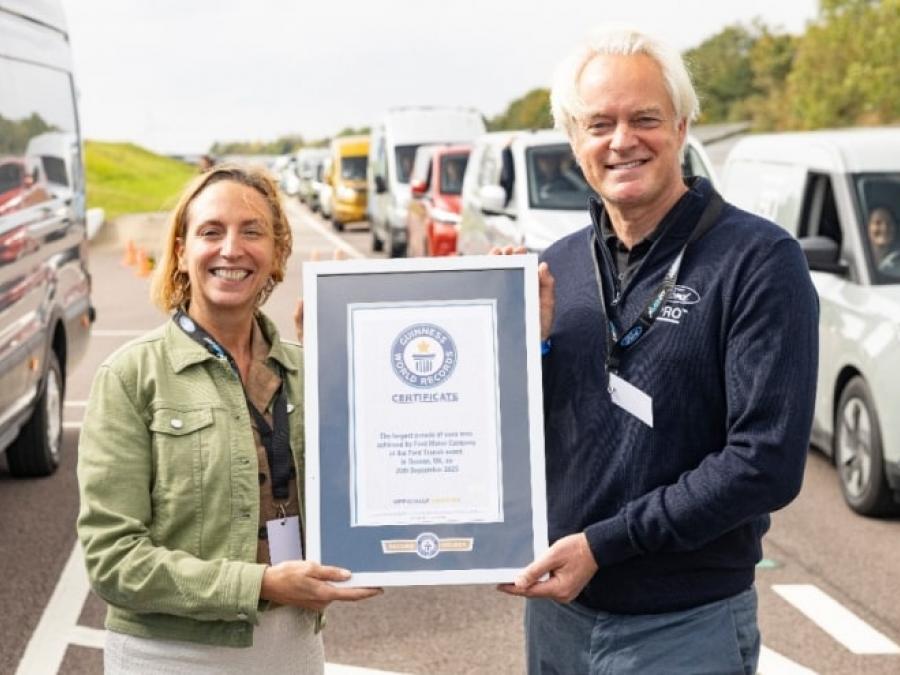
Ford has made history by setting a new Guinness World Records title for the Largest Parade of Vans as part of celebrations marking the 60th anniversary of the iconic Transit.
A total of 201 Ford Transit vans, from classic petrol-powered models to the latest E-Transit and Transit Custom PHEV, took part in the record-breaking convoy. The event united Transit owners, small business operators, dealers, media, and enthusiasts in a remarkable display of community and passion for one of the world’s most versatile vans.
The convoy began at the Ford Dunton Technical Centre in Essex, covering a 29-mile (46 km) route before arriving at the first-ever Transit Festival at Chelmsford City Racecourse. More than 2,500 fans joined the festival, which included workshops on productivity for small businesses, tackling tool theft, and growing businesses through social media.
Lisa Brankin, Chair and Managing Director of Ford of Britain and Ireland, said:
“This record-setting achievement is a testament to the passion Transit inspires and to the versatility of the world’s best-selling cargo van. Our Transit convoy demonstrated the huge variety of services made possible by Ford Pro and Ford’s industry-defining van across six decades.”
The Guinness World Records certificate was officially presented at the event by adjudicator Carl Saville. Each participant also received a digital certificate recognizing their contribution as record-setters.
Peter Lee, Chairman of the Transit Van Club, emphasized the emotional significance of the event:
“Transit has touched millions of lives in its 60 years supporting businesses and communities, and every one of those people is a part of this iconic van’s story. To be involved in this record-setting experience feels extra special.”
Since its debut in 1965, more than 13 million Ford Transits have been produced globally, with either the Transit or Transit Custom being the UK’s best-selling van for 59 consecutive years. The new Guinness World Record is a fitting tribute to the van’s enduring legacy and bright future as it transitions into the electric era.
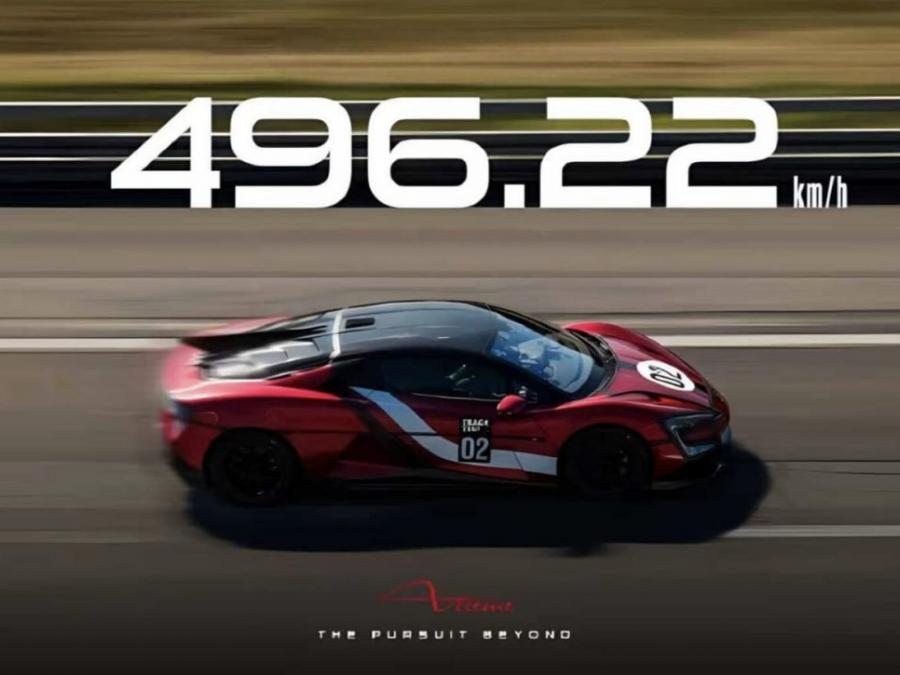
On September 14, 2025, at the ATP test track in Papenburg, Germany, the Chinese electric hypercar Yangwang U9 Xtreme (U9X) reached an astonishing 496.22 km/h (≈ 308.4 mph). This achievement makes it the fastest production car in the world, officially dethroning the legendary Bugatti Chiron Super Sport 300+ (490.48 km/h in 2019).
Cutting-Edge Technology That Breaks Limits
The Yangwang U9 Xtreme impresses not only with its speed but also with its engineering breakthroughs:
-
1,200-volt electrical system – far beyond the 400–800V architecture found in most EVs.
-
Blade Battery (LFP) – BYD’s proprietary technology, known for durability and high discharge performance.
-
Four electric motors with a combined output of over 3,000 horsepower (≈ 3,019 PS).
-
Advanced aerodynamics – large front splitter, dual intakes, massive rear wing, and a double-layer diffuser for stability near 500 km/h.
-
Specialized tires – GitiSport e·Gtr2 Pro, developed to withstand extreme loads at record-breaking speeds.
Dimensions & Limited Production
The U9X measures almost 5 meters in length, 2.03 meters wide, and 1.35 meters tall, with a wheelbase of 2.9 meters, ensuring stability on the track.
Only 30 units will ever be produced worldwide, turning it into a collector’s masterpiece.
Double Victory: Nürburgring Lap Record
Besides the top speed record, the U9 Xtreme also set an impressive lap time at the Nürburgring Nordschleife — 6:59.157 minutes — becoming the first production EV to break the 7-minute barrier.
U9 Xtreme vs Bugatti Chiron Super Sport 300+
| Parameter | Yangwang U9 Xtreme | Bugatti Chiron Super Sport 300+ |
|---|---|---|
| Top Speed | 496.22 km/h | 490.48 km/h |
| Powertrain | 4 electric motors (EV) | W16 petrol engine |
| Output | ~3,019 PS | 1,600 PS |
| Production Run | 30 units | 30 units |
What This Means for the Industry
The Yangwang U9 Xtreme proves that electric cars are no longer just an alternative — they now lead the race in performance. With this record, BYD and its luxury sub-brand Yangwang have overtaken traditional supercar giants like Bugatti, Koenigsegg, and Rimac.
This achievement shows that China is not only catching up but also setting new benchmarks in the hypercar world.
Conclusion
The Yangwang U9 Xtreme is more than just a car. It’s a symbol of technological dominance and a glimpse into the future of automotive engineering. With only 30 units to be made, it will remain a rare icon, remembered as the hypercar that proved China can surpass Europe’s finest in the race for speed.


-

[news] How exotic V8, V12 and even V16 engines a ...
6777777777777777777nPosted by ninja 7 months ago -
-
[news] How exotic V8, V12 and even V16 engines a ...
6777777777777777777777777777Posted by 67 7 months ago -
[news] WEF: The end of the personal car is coming
This is tyranny if ever I heard it. There is no gl [more ...]Posted by Micky 1 year ago -
[news] The new Moskvich 3 gets a new name, petro ...
Nice utüg, congratulations if you can drive itPosted by Mosque Witch 3 years ago -
[news] The new Moskvich 3 gets a new name, petro ...
Battery electric?! Hasn't Russia learned any less [more ...]Posted by Sagradamoly 3 years ago -
[news] An American put a chip on his hand to mak ...
Great article!Posted by Bobby Brown 4 years ago -
[news] Tesla Asks Drivers To Post Fewer Clips Wi ...
Tesla's autopilot needs many more improvementsPosted by Tesla driver 5 years ago