According to a report, the World Economic Forum (FEC) wants to end “wasteful” private vehicle ownership and instead replace it with “communal sharing” of cars in an effort to reduce global demands for fossil fuels and precious metals.
A paper published by WEF argues that private vehicles are not good for the earth and that most vehicles are barely used.
The proposed universal model would take vehicle users “from owning to using” vehicles, thus protecting the planet. In their paper, WEF uses the statistic that shows the average car use in England is only 4%, claiming that it would be easy to share vehicles with other people.
According to WEF, it is time to sell cars that just sit there not getting used and instead walk or share vehicles because “car sharing platforms such as Getaround and BlueSG have already seized that opportunity to offer vehicles where you pay per hour used.”
WEF said that in order to save the planet, the end of private ownership is required and applies to everything, including cars, private homes and even “city-wide design principles.” WEF added:
“A design process that focuses on fulfilling the underlying need instead of designing for product purchasing is fundamental to this transition.”
WEF stated:
“This is the mindset needed to redesign cities to reduce private vehicles and other usages.”
It seems that WEF is not the only organization that wants people to give up personal car ownership. The International Energy Agency (IEA) told global governments they need to cut the amount of oil supply to domestic consumers and “nudge” people out of their private cars to lower consumption.
IEA allegedly has a plan to reduce the consumption of gas by reducing speed limits, having more electric cars, constructing more cyclist lanes, implement cheap public transport, use long-distance trains instead of airplanes, and have people work from home at least three days per week.
IEA stated that these “changes” in the behavior of consumers are necessary for the benefit and survival of the planet.
One example of these “changes” is Ireland’s 10-year “Climate Action Plan 2019” (CAP), which forces vehicles off the road and packs people into “higher density” cities. The CAP is “revolutionizing people’s lives” in order to stop the coming “climate apocalypse.”
In order to avert the “climate apocalypse”, the government plans to force people “out of private cars because they are the biggest offenders for emissions” with proposals that include banning fossil fuel vehicles from towns and cities nationwide to intentionally cripple ordinary motorists.
According to reports, a number of European nations and U.S. states have already passed legislation that will ban the sale of non-electric cars as soon as 2030. Washington, New York and California have already passed such measures.
Forbes reported that some cities in Europe are starting to introduce charges for using personal vehicles, with extra fees on the top for more polluting vehicles, such as London’s Ultra Low Emission Zone or Bristol’s Clean Air Zone.
The advent of autonomous taxies, which are already in commercial use in China, could also make on-demand ride hailing even easier than the likes of Uber and Lyft. Electric vehicles also throw a further complication into the mix of car buying and owning.

Crews responded to an electric bus fire in the parking lot of the CT Transit Bus Depot on State Street this morning. Lithium ion battery fires are difficult to extinguish due to the thermal chemical process that produces great heat and continually reignites. Exposures were protected at the scene. Two CT Transit workers were transported as a precaution from exposure to the smoke and one firefighter was transported for heat exhaustion. The Fire Marshal is investigating the incident.
It comes just a day after the governor of Connecticut demanded that all cars in the state run on electricity in the future.
Self-ignitions of electric vehicles have been on the rise recently, and the consequences are always a completely burnt vehicle and, in not a few cases, other cars around them.
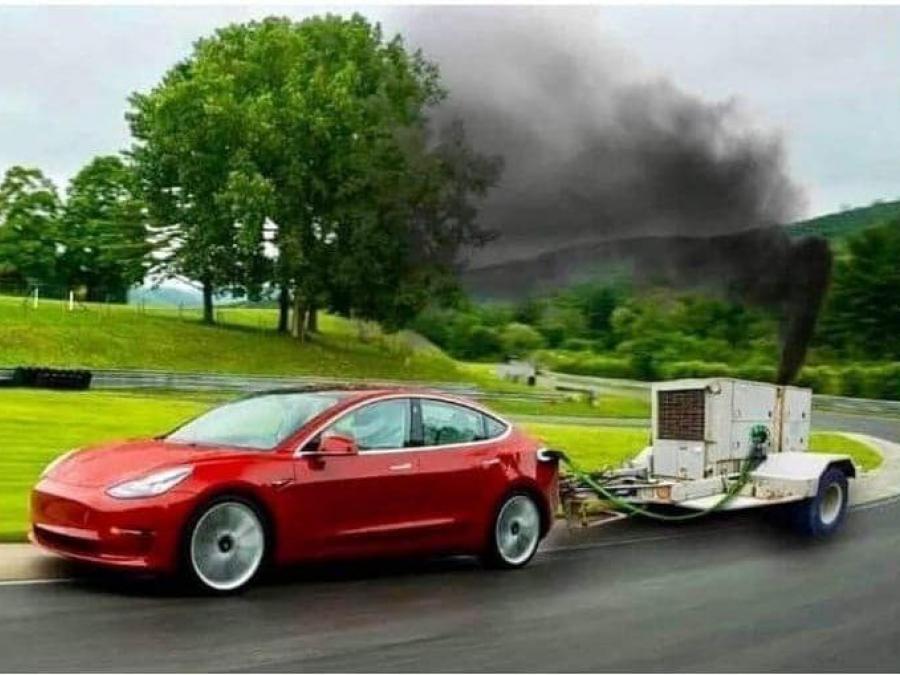
In France, due to energy savings, owners of electric vehicles have been hit.
The fact is that now it is allowed to charge the battery only up to 20 kW, which is enough for about a hundred kilometers of driving. And then - look for a new charge. One can imagine how owners of cars with internal combustion engines look at the owners of advanced vehicles now, and despite the fact that gasoline is now also expensive.
However, there is a way out. And he is in the photo attached to the post.
All over Europe there is talk of a return to coal, and very soon, with the arrival of winter, all green innovations will be left for better times.


-

[news] How exotic V8, V12 and even V16 engines a ...
6777777777777777777nPosted by ninja 5 months ago -
-
[news] How exotic V8, V12 and even V16 engines a ...
6777777777777777777777777777Posted by 67 5 months ago -
[news] WEF: The end of the personal car is coming
This is tyranny if ever I heard it. There is no gl [more ...]Posted by Micky 1 year ago -
[news] The new Moskvich 3 gets a new name, petro ...
Nice utüg, congratulations if you can drive itPosted by Mosque Witch 3 years ago -
[news] The new Moskvich 3 gets a new name, petro ...
Battery electric?! Hasn't Russia learned any less [more ...]Posted by Sagradamoly 3 years ago -
[news] An American put a chip on his hand to mak ...
Great article!Posted by Bobby Brown 4 years ago -
[news] Tesla Asks Drivers To Post Fewer Clips Wi ...
Tesla's autopilot needs many more improvementsPosted by Tesla driver 5 years ago